How Long Do NDAs Last? Typical Terms, Limits and Sample Clauses
You signed an NDA years ago, or you’re about to ask someone to sign one, and now the question is simple: how long does it actually last? The honest answer is “as long as it says”. But most NDAs actually say two different things, and the law adds a few limits of its own.
This guide explains how NDA duration works in plain English: the typical lengths, the difference between the NDA term and the confidentiality period, when an NDA can last forever, what happens when there’s no end date, and how the rules differ in the US, the UK and a few other countries. You’ll also find sample duration clauses you can adapt.
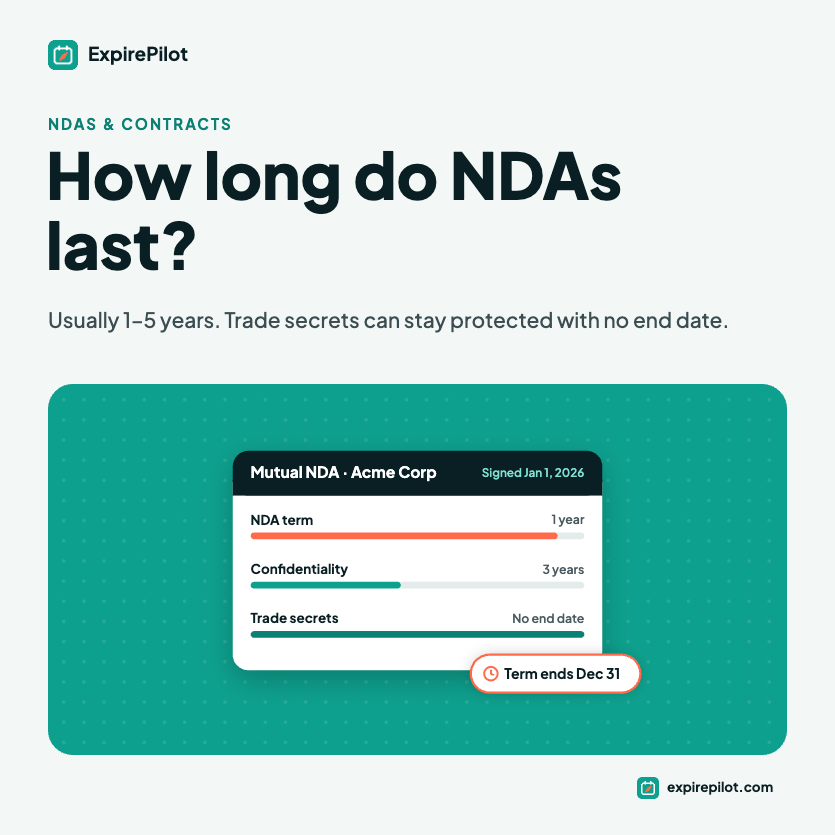
Quick answer: most NDAs last 1 to 5 years, and 2 to 3 years is the most common confidentiality period. Trade secrets are the exception: they can stay protected for as long as they remain secret, which can mean indefinitely. Many NDAs have two clocks: a short term for sharing information (often 1 year) and a longer confidentiality period that keeps running after the NDA ends.
This guide is general information, not legal advice. NDA rules depend on the exact wording and on the law that governs the agreement, so ask a lawyer about a specific contract.
How long does an NDA usually last?
There’s no legal default. An NDA lasts for whatever period the parties agree, as long as a court would see that period as reasonable. In practice, though, the numbers tend to cluster in a narrow range:
- 1 year is the most common term (the window for sharing information). In Common Paper’s benchmark of contracts from more than 150 US B2B SaaS companies, 51% of NDAs had a 1-year term, 17% had 2 years and 8% had 3 years.
- 1 to 2 years is the most common confidentiality period in fast-moving tech deals. The same benchmark found 52% of NDAs used a 1-year confidentiality period, and Common Paper’s later reports name two years as the most-used confidentiality term.
- 3 or 5 years is the usual range in UK guidance. The UK Intellectual Property Office’s NDA guidance says it’s common to see confidentiality limited to 3 or 5 years.
- No end date for trade secrets. In the Common Paper data, 15% of NDAs had no expiry at all, so the confidentiality duty lasts indefinitely.
What’s the difference between the NDA term and the confidentiality period?
This is the part most people miss. A well-drafted NDA typically has two separate time periods:
| Period | What it controls | Typical length |
|---|---|---|
| NDA term (also “disclosure period”) | How long the parties can share information that the NDA covers | 6 months to 2 years |
| Confidentiality period (also “survival” or “protection period”) | How long the receiving party must keep that information secret | 1 to 5 years, often counted from the end of the term or from each disclosure |
| Trade secret carve-out | Information that qualifies as a trade secret | As long as it remains a trade secret |
Here’s how it plays out. You sign a mutual NDA on January 1, 2026 with a 1-year term and a 3-year confidentiality period counted from disclosure. You share a pricing model in October 2026. The NDA term ends on December 31, 2026, so anything shared after that date isn’t covered. But the pricing model must stay confidential until October 2029.
So when someone asks “has my NDA expired?”, you have to check two dates: when the agreement ended, and how long the survival clause keeps the duty alive after that. And check what the clock actually counts from. “Three years from the effective date” ends much sooner than “three years from the last disclosure”.
How long do different types of NDAs last?
The right length usually depends on the relationship and the information. Here are the common market ranges; they’re not legal limits:
| NDA type | Typical confidentiality period | Notes |
|---|---|---|
| Sales or partnership talks (mutual NDA) | 1 to 3 years | Often a 1-year term; information goes stale quickly |
| Vendor or supplier | 2 to 5 years, or the length of the contract plus 2 to 3 years | Often folded into the master services agreement |
| Contractor or freelancer | 2 to 5 years after the engagement ends; trade secrets indefinitely | Usually paired with an IP assignment clause |
| Employee confidentiality agreement | During employment plus 1 to 5 years; trade secrets indefinitely | Some states require a time limit for non-trade-secret information |
| Investor or fundraising | 1 to 2 years, if one is signed at all | Many venture investors refuse to sign NDAs at the pitch stage |
| M&A (acquisition talks) | 2 to 3 years after the talks end | Often includes non-solicit and “standstill” terms with their own dates |
| Settlement agreement | Often no end date | Limited by law for harassment and discrimination claims (see below) |
| Entertainment, reality TV, celebrity staff | Often no end date | Usually perpetual, with large pre-set penalties; enforceability varies |
Can an NDA last forever?
Yes, for the right kind of information. Trade secrets are protected for as long as they stay secret, so an NDA can validly keep a duty of confidentiality on them with no end date. The EU’s Trade Secrets Directive works the same way: protection lasts as long as the information meets the definition of a trade secret, with no registration and no fixed term.
But general confidential information is different. Business plans, prices and project details tend to lose value over time, and some courts won’t enforce a “forever” clause on them:
- Illinois law says a duty to keep a trade secret confidential isn’t void just because it has no time or geographic limit (765 ILCS 1065/8(b)(1)).
- Wisconsin treats employee NDAs as restrictive covenants under Wis. Stat. § 103.465. If a clause covers both trade secrets and other information with no time limit, Wisconsin courts have refused to enforce it.
That’s why many NDAs use a split, so that each kind of information gets a period a court is likely to accept: a fixed period (say 3 years) for ordinary confidential information, and “for as long as it remains a trade secret” for trade secrets.
UK courts tend to take a similar practical view. As Orrick notes, there’s no default expiry under UK law, but courts are unlikely to enforce confidentiality over information that’s already public or has lost its commercial value.
What happens if the NDA has no end date?
If an NDA says nothing about duration, the starting point is that the confidentiality duty continues. But “continues” doesn’t mean “forever, no matter what”. In practice:
- It still ends when the information becomes public through no fault of the person who signed.
- A court may read in a reasonable period for ordinary business information, or refuse to enforce the clause if it’s too broad.
- Trade secrets stay protected while they remain secret, whatever the NDA says.
- State rules can override it. In a state like Wisconsin, an employee NDA with no time limit on non-trade-secret information may not be enforceable at all.
If you’re the one drafting, don’t leave it blank. A clear end date for ordinary information, plus a trade secret carve-out, is usually easier to enforce and easier for the other side to accept.
When does an NDA end early or stop being enforceable?
An NDA can stop binding someone before its written end date, or never bind them on certain topics at all:
- The information becomes public without a breach. Most NDAs say so expressly, and the UK IPO guidance makes the same point: once information is public, an NDA can’t be enforced over it.
- The receiving party already knew it, or developed it independently. These are standard exclusions in most NDAs.
- A court or regulator compels disclosure. Most NDAs allow disclosure required by law, usually with notice to the other party first.
- The parties end it in writing, or a later agreement replaces it.
- The clause is unreasonable: too broad, too long or contrary to public policy.
Legal carve-outs in the US
And some disclosures are protected however long the NDA runs:
- Speak Out Act (2022). Courts can’t enforce a non-disclosure or non-disparagement clause agreed before a dispute to stop someone talking about sexual assault or sexual harassment. It applies to employees and independent contractors and doesn’t affect ordinary trade secret protection.
- Defend Trade Secrets Act (2016). A person can’t be held liable under trade secret law for disclosing a trade secret in confidence to a government official or a lawyer to report a suspected violation of law (18 U.S.C. § 1833(b)). Employers must give notice of this immunity in agreements that cover trade secrets, or they lose some remedies.
- SEC Rule 21F-17. No one may use or threaten to enforce a confidentiality agreement to stop someone from reporting a possible securities law violation to the SEC. The SEC has fined companies over NDA wording alone.
- State laws. California’s Silenced No More Act (SB 331, in force since January 1, 2022) limits NDA terms in workplace harassment, discrimination and retaliation settlements and in employment agreements. Other states have their own rules.
How long do NDAs last in different countries?
No major country sets a standard NDA length by law. So the real differences are in how courts judge “reasonable” and which disclosures the law protects.
| Country | Default length | Common in practice | Main limits |
|---|---|---|---|
| United States | None; state contract law applies | 1 to 5 years; trade secrets indefinitely | Reasonableness test; Speak Out Act, DTSA immunity, SEC rules, state laws (e.g. California, Wisconsin) |
| United Kingdom | None | 3 or 5 years (UK IPO guidance) | No enforcement over public information; reporting crimes protected since October 2025; harassment and discrimination NDA limits coming |
| European Union | None at EU level | 2 to 5 years | Trade Secrets Directive (2016/943) protects trade secrets with no time limit, with exceptions for whistleblowing |
| Canada | None | 2 to 5 years | Prince Edward Island’s Non-disclosure Agreements Act limits NDAs about harassment and discrimination |
| Australia | None | 2 to 3 years (market standard) | Courts may refuse unreasonable restraints |
United Kingdom
There’s no default expiry under UK law, and UK IPO guidance says 3 or 5 years is common, while things like non-patentable know-how and customer lists may be kept confidential forever. Two newer rules matter for employers:
- Victims and Prisoners Act 2024, section 17 (England and Wales, from October 1, 2025): an NDA can’t stop a victim of crime from reporting it to the police and certain other people and bodies.
- Employment Rights Act 2025: once in force, clauses that stop a worker speaking about harassment or discrimination, or the employer’s response to it, will be void. The government consulted on the details in 2026 and has said it plans to bring the change in during 2027.
European Union
Each member state applies its own contract law, but the Trade Secrets Directive sets a common floor: breaching a confidentiality agreement to use or disclose a trade secret is unlawful, and the protection has no time limit while the information stays secret. The directive also protects whistleblowers who reveal wrongdoing in the public interest.
Canada and Australia
Neither country has a default NDA term. In Canada, Prince Edward Island’s Non-disclosure Agreements Act (assented November 2021) was the first provincial law to limit NDAs in harassment and discrimination cases. In Australia, LegalVision describes 2 to 3 years as the market standard term.
Sample NDA duration clauses
You can adapt these to your agreement. Just have a lawyer check the final wording, so that it fits the law that governs your contract.
1. Fixed term with survival
Term. This Agreement starts on the Effective Date and ends one (1) year later, unless either party ends it earlier with 30 days' written notice. The Recipient's obligations for Confidential Information disclosed during the term survive for three (3) years after the date of each disclosure.
2. Fixed period plus a trade secret carve-out
Duration of Obligations. The Recipient will keep Confidential Information confidential for three (3) years after the end of this Agreement. For any Confidential Information that is a trade secret under applicable law, these obligations continue for as long as that information remains a trade secret.
3. Relationship-based (vendors and contractors)
Duration. The confidentiality obligations in this Agreement apply during the Services Agreement and for two (2) years after it ends or expires, and for trade secrets, for as long as they remain trade secrets.
4. Permitted disclosures (recommended in US agreements)
Protected Disclosures. Nothing in this Agreement prevents the Recipient from reporting possible violations of law to a government agency, from making disclosures protected by whistleblower laws, or from discussing or disclosing information about unlawful acts in the workplace. [Insert the notice of immunity under 18 U.S.C. § 1833(b).]
Other common questions about NDA length
Do NDAs ever expire?
Most do. A fixed-term NDA expires on its end date, and its confidentiality duty expires when the survival period runs out. Duties covering trade secrets may never expire while the information stays secret.
Can an NDA last 10 or 20 years?
It can, if the information really stays valuable that long, such as a manufacturing process or a long-life drug formula. For ordinary business information, a court may find 10 or 20 years unreasonable. If the information is a trade secret, a “for as long as it remains a trade secret” clause is usually safer than a long fixed number.
Do NDAs expire after death?
It depends on the wording. Many NDAs say they bind the parties’ “heirs, executors, successors and assigns”, which can carry the duty to an estate. Where a company is the party, the NDA usually continues after any individual dies, and it often survives a sale or merger of the company as well. Without such a clause, the answer turns on local law, so ask a lawyer.
How long do celebrity and reality TV NDAs last?
Usually with no end date, and often with large pre-set penalties for breach. Networks say these clauses exist mainly to stop spoilers before a show airs. After 2023 legal challenges, NBCUniversal said its reality TV NDAs aren’t meant to stop cast and crew from disclosing unlawful acts in the workplace. In the US, the Speak Out Act and state laws like California’s also limit what any NDA can silence.
Is it ever legal to break an NDA?
Yes, in specific cases: reporting a crime or suspected violation of law to the authorities, making a protected whistleblower report, responding to a court order, or (in the US) talking about sexual harassment or assault despite a pre-dispute NDA. Outside those cases, breaking an NDA can lead to damages, a court order to stop, or a pre-set penalty.
Does an NDA end when I leave my job?
Usually not. Most employee confidentiality clauses survive the end of employment, for a fixed period for ordinary information and indefinitely for trade secrets. Check the “survival” or “term” section of your agreement.
How to keep track of NDA end dates
NDAs are often the contracts a company signs most, and they tend to be the ones nobody tracks once they’re signed. And that causes two problems: you keep treating expired information as protected, or you share new information under an NDA whose term has already run out. A simple register fixes both. For each NDA, record:
- The other party, and whether the NDA is mutual or one-way
- Effective date and term end date
- Confidentiality end date, and what it counts from (signing, end of term or each disclosure)
- Whether trade secrets are carved out with no end date
- The internal owner, and a link to the signed copy
Then you can set a reminder about 30 to 60 days before each term ends, so the owner can decide whether to renew it, replace it with a full contract, or let it lapse. Our free contract tracking template already has columns for this.
To give you a concrete example, at ExpirePilot, we suggest teams don’t simply enter the date an NDA was signed. We have them record the date the confidentiality duty actually ends, and send the reminder to the person who owns that relationship, so that renewing an NDA or letting it lapse is a decision rather than an accident.
14-day free trial · No credit card
Know when every NDA and contract ends
ExpirePilot keeps your NDAs, contracts and their end dates in one place and emails the owner before each one runs out, with escalation to a manager if nobody acts. Upload the signed PDF and AI reads the dates for you. Try every Business feature free for 14 days, then stay on the Free plan or pick a paid plan.
✓ No credit card needed ✓ Free plan after the trial ✓ Nothing is deleted
Where ExpirePilot fits
ExpirePilot is contract reminder software for teams that need end dates to reach the right person in time. It doesn’t draft or negotiate NDAs; it makes sure you know when each one ends.
- Expiration reminders by email at the timing you choose, for example 60, 30 and 7 days before an NDA ends.
- Reminder escalation to a manager when the owner doesn’t act.
- AI document scanning that reads the dates from an uploaded NDA or contract.
- Audit reports in Excel, CSV and PDF.
See plans and pricing.
Disclosure: ExpirePilot is our product. Nothing in this guide depends on using it.
Sources
- Common Paper: 2022 Contract Benchmark Report and Mutual NDA
- UK Intellectual Property Office (GOV.UK): Non-disclosure agreements
- GOV.UK: Victims and Prisoners Act 2024: changes to non-disclosure agreements
- Browne Jacobson: Employment Rights Act 2025: consultation on preventing misuse of NDAs
- Orrick: Do NDAs last forever under UK law?
- Gibson Dunn: Speak Out Act signed into law (December 2022)
- Goodwin: Defend Trade Secrets Act and whistleblower immunity notice
- Debevoise & Plimpton: SEC Rule 21F-17(a) settled actions
- Illinois General Assembly: 765 ILCS 1065/8
- Axley: Wisconsin nondisclosure agreements and Wis. Stat. § 103.465
- Akin Gump: California’s Silenced No More Act
- EUR-Lex: EU rules on protecting trade secrets (Directive 2016/943)
- Stewart McKelvey: Prince Edward Island’s Non-Disclosure Agreements Act
- LegalVision: Can I vary or extend an NDA?
- TV Insider: Bravo clarifies use of reality TV NDAs
Last reviewed: November 17, 2026. Laws on NDAs are changing in several countries; we recheck this guide every 6 months.
